Act I: The Fucking Foreplay
You all know the drill. You hear the magic word—SEQUEL—and the blood runs cold, not from fear, but from disappointment. It’s a studio contract, a cash-grab, a cynical, focus-grouped piece of cinematic product designed to wring a few more dollars out of a perfectly finished corpse. It’s a mandatory encore nobody asked for, usually performed by a band that ran out of ideas three albums ago.
And when you’re talking about Wes Craven’s Scream, which in 1996 had already dragged the entire rotting carcass of the slasher genre out of the grave and slapped a postmodern university degree on its forehead, the sequel felt less like a necessity and more like an insult. It was Hollywood trying to catch lightning in a bottle twice. That lightning? It usually just smells like piss and burnt plastic the second time around, proving the formula is bankrupt and the motivation is purely fiscal.
So, here we stand, nearly twenty-nine years later at the time of me writing this, staring down the barrel of Scream 2. It’s a film that shouldn’t work, a rushed product that, by all accounts, was being rewritten in the parking lot as they filmed. Yet, somehow, it sticks to the ribs like stale beer, cheap adrenaline, and a half-healed knife wound. My thesis is simple—and if you’re looking for high-brow film theory, you can go read a textbook; I speak from the pit, not the pulpit—Scream 2 is either an accidental masterpiece of sustained trauma or a perfectly engineered, cynical piece of studio-mandated gold.
And quite frankly, I don’t give a fuck which it is. It hits. It takes the groundwork of the first film and hammers it down into something sharper, uglier, and ultimately more resonant. It is the necessary violation that moves the series from a clever joke to a genuinely frightening reflection on American celebrity and violence.
The Bloody Overture: Complicit In The Gore
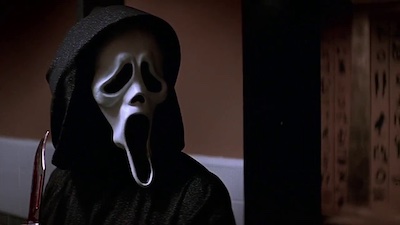
The film doesn’t open; it kicks the door down and drags you into the theatre lobby, covered in fake blood and the scent of stale popcorn. We’re at the premiere of Stab—the movie-within-a-movie based on the Woodsboro massacre, which is already meta enough to make your brain seize up. But this isn’t about cleverness; it’s about culpability.
Forget the film-within-a-film bullshit for a second. Look at the crowd. They’re maniacs. They’re dressed in Ghostface robes, screaming for blood. When Omar Epps’ character, Phil, gets brutally slaughtered in the restroom, we – the real life paying crowd – are already laughing, already in on the joke. The when Jada Pinkett Smith’s Maureen is gutted on the theatre stage, writhing in her own blood, the crowd watching Stab thinks it’s a fucking stunt. They cheer. They applaud. Just as we all were a few moments earlier. They are as complicit in this ritual as we are.
This isn’t just a kill; it’s an indictment. The true horror here is the audience – both in-movie and in-theatre – watching a human being die, consumed by the spectacle they paid twelve bucks to see. It’s an unflinching, anti-corporate shot across the bow of Hollywood, showing the industry and the fans exactly how they’ve turned a real-life atrocity—Sidney Prescott’s nightmare—into a Saturday night thrill. The gore is on stage, but the moral decay is in the stalls. It’s heavier than a busload of sumo wrestlers, because it’s not just a slasher opening—it’s a commentary on us, the consumers, the sick bastards who keep this whole cynical machine running. It’s the film saying: You asked for more, and here is the mirror. Hope you enjoy the show.
The Return to the Pit: The Campus Lie
The setting is Windsor College and the sequel rule is simple: take the characters out of their element and isolate them. Sidney Prescott, poor, traumatized Sidney, is trying to start over. She’s surrounded by bright, sunny sorority girls, a handsome, stable boyfriend (Derek, a beautiful lie), and a theatre class where she’s playing fucking Cassandra—the one who sees the future but nobody believes. It’s perfect. The setup is already screaming tragedy.
Yet, the college campus is a lie. It’s supposed to be safe. It’s supposed to be full of fake-ass security guards, self-important students, and pristine, protected lawns. It’s the ultimate setup for a false sense of safety, and you know it’s bullshit the moment you see the pristine walls.
And who returns? The glorious, wounded warriors:
Gale Weathers, the corporate ghoul who wrote a best-selling book off Sidney’s nightmare. She is the media vampire, perpetually chasing the next exclusive, the next book deal.
Dewey Riley, the brave-yet-clumsy former deputy who wears his scars like a badge of honour. He’s a comfort, a symbol of stability, and therefore, a prime target.
They’re dragged back, like moths to a flame, because trauma and tragedy are the only things that hold these people together. They can’t escape the orbit of the first movie; they are the Final Girl, the Survivor, and the Leech, doomed to repeat the cycle until the credits roll, or until they bleed out on some stupid Greek staircase. The college isn’t a new start; it’s just a bigger, more prestigious asylum.
Act II: The Expressive Body
The thing about Scream 2 is that it flows like a monologue—fast, rhythmic, conversational, but with the underlying tension of a razor held to your throat. The dialogue crackles with the energy of a dive bar at 2 a.m., fueled by caffeine and paranoia, the kind of manic intensity that only true terror can generate.
The Rules, Re-Scored: The Dagger
Enter Randy Meeks. God bless the horror geek. He’s here to deliver the rules for surviving a sequel—in a self-parody that makes Scream what it is. He’s standing there, on a quad full of obliviously safe college kids, laying down the law:
“The body count is always bigger.”
“The death scenes are always much more elaborate—more blood, more gore, carnage candy…”
“Never, ever assume the killer is dead.”
And he’s right, of course. He’s laying the blueprints for the next ninety minutes of slaughter. But here’s the rub, the fucking dagger in the meta-ness: by stating the rules, the film feels both clever and utterly trapped. It’s waving a banner saying, “Look how smart we are!” while simultaneously checking off a mandated, cynical studio list.
And then they kill Randy.
The fucking assholes. They kill the self-aware voice of the audience, the one character we trusted to narrate the carnage. That’s the moment the gloves come off. It’s a vicious, abrupt death in a sound van, a private murder broadcast to no one. It’s like the movie itself got sick of being smart and decided to just be brutal. It’s a violation that feels earned and necessary to push the sequel past being a mere joke. The fun is is over, you dumb-ass. This is serious now. By silencing the meta-commentator, the film forces you to experience the violence directly, without the safety net of intellectual irony. The rules are irrelevant now; the blood is real.
Trauma as Celebrity: The Spotlight Kills
The real horror here isn’t the knife; it’s the spotlight. Sidney Prescott is the ‘Final Girl’ trapped on a fucking poster. The world knows her story. They watched the movie. They read Gale’s book. She’s not just a victim; she’s a commodity. She is the center of a morbid pop culture phenomenon.
The film spends a considerable amount of its running time dealing with the media frenzy. Gale Weathers, the corporate ghoul, shows up and the bodies follow. She is a parasite, feeding on tragedy. She represents everything the horror philosophy rejects: the hype, the industry polish, the glamourization of true pain. Even when she’s helping, she’s filming it. She’s selling it. She is the living embodiment of the cynical machine that took a town’s tragedy and turned it into a blockbuster franchise. Her constant presence is a deliberate form of psychological torture for Sidney.
The brilliance is in how Sidney is forced to re-engage. She’s trying to have a life—a cute boyfriend, friends—but she’s a magnet for maniacs seeking vicarious fame. Her only path forward is to accept the mask, the trauma, the inevitable. This is the anti-corporate spirit at work: the machine chews up the genuine article and spits out a product called Stab. The only way to win is to fight within the frame they’ve established, to take control of her own narrative by wielding the knife herself.
The Cassandra Complex: The Genuine Soul
Amidst the chaos, we get the theatre class. Sidney, playing Cassandra—the prophetess cursed to be right, but never believed. This is the Gothic poetry moment. It’s the film’s beating, bleeding heart, a respite from the cynical snark. It provides the intellectual and emotional justification for Sidney’s unique brand of paranoia.
When the Ghostface chase bleeds onto the stage during her rehearsal, the line between art and atrocity snaps completely. She’s playing a girl haunted by the truth, and then the truth walks onto the stage with a knife. This is the counterpoint to the profanity, the moment where the film transcends the gallows humor. It shows her emotional core, her inner struggle for agency. She is fighting a battle not just against the killer, but against the destiny the first film wrote for her. It’s poetic, but never pretentious—just raw feeling, bleeding out under the stage lights as the audience (the killer included) watches the performance.
The Chase, The Gore, The Soul
Scream 2 had to get heavier to justify it existence. It couldn’t just repeat the game; it had to raise the stakes and the impact. And it did. The film is full of sensory, cinematic brutality that sets it apart.
Forget technical jargon; let’s talk sensation.
The sound booth scene: When the killer attacks Randy and Gale, the bass hits like a fucking earthquake under your ribcage. The sound is muffled, distorted, like a panicked yell played through slashed speakers. The fear is palpable because you feel the sound, not just hear it. It’s a sonic assault that disorients the viewer just as much as the characters.
The police car crash: This is a visceral, anatomically aggressive scene. That car flips, and you feel the sickening crunch of metal and bone. Sidney and Hallie scrambling over a dying cop, the knife inches from their faces. It’s like being kicked out of a fucking plane without a parachute. No humor. Just cold, frantic terror, compounded by the horrifying necessity of having to climb over a corpse to survive.
These are the moments that cement the film’s underground reverence. It champions the craft of heavy cinema, the ability to make the audience feel the movie rather than just understand the plot. These moments are relentless, alternating between blunt impact and flowing panic. There is no corporate structure here, just the raw rhythm of survival etched in blood and shattered glass.
Act III: The Closing Ritual
The climax moves to the college’s Greek theater, a classical, beautiful ruin—the perfect stage for the final, bloody performance. The theater, the symbol of high art and intellectualism, is consecrated with blood, proving that no sanctuary is safe from the ghosts of the past, and just when Scream 2 needed to go out with a bang we get…
The Unmasking, The Whimper
The climax reveal—two killers again. A repeat of the first act, but with a thematic twist.
Mickey, the psychotic film student obsessed with blaming the movies.
Debbie Salt (aka Mrs. Loomis), Billy’s mother, out for revenge.
Is it a genius move? No. It’s a messy, over-the-top, Scooby-Doo ending. And that’s the beauty of it. The killers’ motivations are pure, over-the-top melodrama: revenge and fame.
Mrs. Loomis is the ultimate mama bear, her grief turning into a shotgun-wielding rampage. Her motive is the most classic and primal: maternal rage. She is the literal ghost of Sidney’s past returning, seeking an eye for an eye.
Mickey is the cynical voice of the sequel rules—he wanted to be caught, to blame the cinema for his sickness, thus proving the very point the whole franchise argues about: the influence of media violence. He seeks not justice, but celebrity. He wanted his trial to be the biggest show in town.
The film could have ended quietly, but this is Hollywood, so it had to end with a firestorm of bullets and screaming. The fight itself is frantic, ugly, and ultimately satisfying because it’s so personal. It all boils down to Sidney fighting the literal ghost of her past while Gale and Dewey fight their own battles with survival and ethical compromise.
Final Thoughts
Scream 2 is chaos of ambition. It’s smarter than it needs to be, uglier than it pretends to be, and ultimately, far more fucking effective than any sequel had the right to be.
It takes the high-concept brilliance of the original and drags it into the gutter of celebrity, trauma, and media sensationalism. It doesn’t just deconstruct the sequel; it dissects the audience’s sickness, their desperate need to see the same horror, only bigger, bloodier, and more famous. It is a mirror reflecting the industry’s greed and the audience’s insatiable thirst for spectacle.
It’s the film where the Final Girl stops running and decides to fight on her own terms, where she finally accepts that the trauma is a permanent part of her life and that she must wield it as a weapon. It’s authentic, raw, and full of dark and twisted humor—the kind that breaks the tension before the knife plunges. It’s not perfect; it’s a beautiful, bloody mess with a soul.
Like being swallowed whole by Hell itself—and loving every fucking second of the descent. It is a savage, necessary piece of cinema that proves the sequel is not always a cash-grab; sometimes, it’s a blood ritual that delivers.
Leave a Reply